designer
Akitoshi Kawazu
河津秋敏
Every game should feel like you've never played it before — even if you have.
About
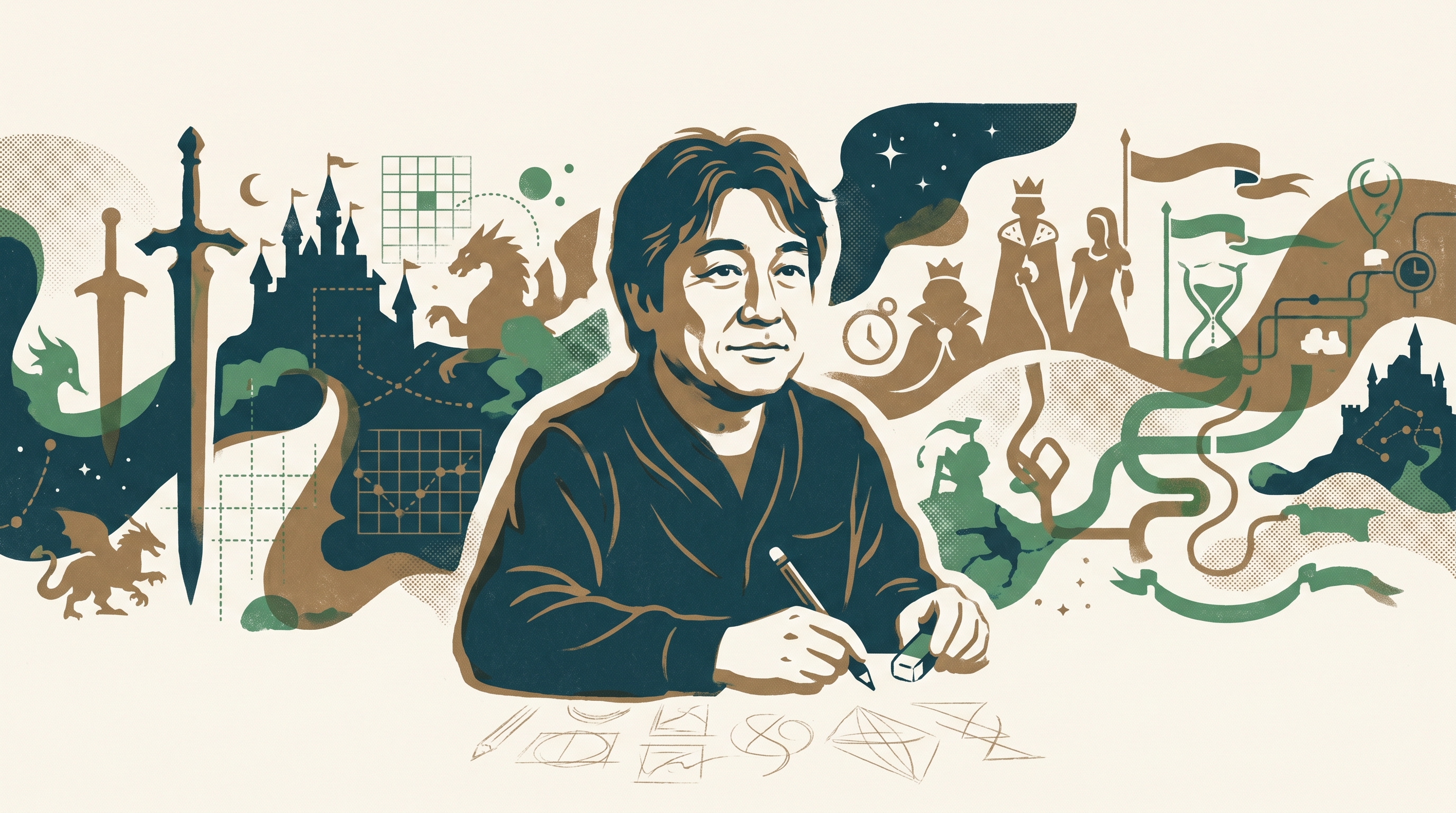
Akitoshi Kawazu is a Japanese game designer, director, and producer who joined Square in 1985. He created the SaGa series — starting with The Final Fantasy Legend (1989) on Game Boy — and has led nearly every SaGa title since. Before that he worked as battle designer on the first two Final Fantasy games. His design philosophy centres on experimental systems, non-linear storytelling, and pushing against the perceived limits of what role-playing games can be.
History
Akitoshi Kawazu was born on November 5, 1962. He joined Square (later Square Enix) in 1985, arriving at a company that had yet to release the game that would define it. His first assignment was as a graphic designer on Rad Racer. The following year he was moved to battle design for the first Final Fantasy.
Final Fantasy had been conceived as a last attempt — creator Hironobu Sakaguchi planned to leave the industry if it failed. It did not fail. The game sold enough to keep Square alive, and Kawazu stayed on to design battles for Final Fantasy II (1988). Those two games taught him the architecture of turn-based combat, but they also showed him the edges of what a conventional RPG could be. He wanted to push past those edges.
In 1989, Kawazu was given the chance to design his own game for the Game Boy. The result was Makai Toushi SaGa (released in North America as The Final Fantasy Legend). It was experimental by design: a vertical tower structure instead of an open world, a party system where characters could die permanently and be replaced, and a leveling system that behaved differently for humans, mutants, and monsters. The game became Square's first million-seller and established Kawazu as the creator of a new series.
He followed it with SaGa 2 (1990) and SaGa 3 (1991), but SaGa 3 was developed largely without his involvement — he had moved on to what would become Romancing SaGa (1992) for the Super Famicom. Romancing SaGa introduced a structure that would define Kawazu's career: eight playable protagonists with intersecting stories, a non-linear quest flow where player choices determined which events became available, and a battle system built on weapon durability and technique acquisition through repeated use. The game was commercial and creative, but it was also divisive. Some players were confused by the lack of a single narrative path. Others felt liberated.
Kawazu continued refining his approach with Romancing SaGa 2 (1993), which introduced a generational system — the player controlled not a single hero but a lineage of emperors spanning centuries. Skills and territory carried forward; individual rulers did not. It was a game about legacy rather than individual triumph. Romancing SaGa 3 (1995) followed, along with SaGa Frontier (1997) and SaGa Frontier 2 (1999), each testing different structural ideas. He also created the Final Fantasy Crystal Chronicles subseries and worked on The Last Remnant (2008).
Critics and players have described Kawazu's games as brilliant, obtuse, unforgiving, visionary, and frustrating — sometimes all at once. His design philosophy, repeated across interviews, centres on the belief that every game should try something new, that limitations can be creative opportunities, and that players should have the freedom to fail. He has said he was influenced by tabletop role-playing games like Dungeons & Dragons and Wizardry, where the rules created possibility rather than a fixed path.
As of 2026, Kawazu remains active at Square Enix, continuing to direct and produce SaGa titles. The series celebrated its 35th anniversary in 2024. In interviews, he has said he wants each SaGa game to feel like something the player has never experienced before — even if they have played every previous entry. That commitment to unfamiliarity is what makes his work difficult to describe and difficult to forget. He builds games that resist being finished in the conventional sense. They are designed to be lived in, tested against, returned to. The lesson is not that every game should be like his. It is that a game can be built to value discovery over guidance, and that some players will choose that path every time.
Timeline & Works
Career milestones and all 4 games in the museum they worked on — in the order they happened.
- 1962 11
Born
Born on November 5, 1962.
people - 1985
Joined Square
Joined Square as a graphic designer. First assignment: Rad Racer.
people - 1987
Final Fantasy — Battle Designer
Designed battle systems for the first Final Fantasy, which became a hit and saved Square from bankruptcy.
product - 1988
Final Fantasy II — Battle Designer
Continued as battle designer on Final Fantasy II, learning the architecture of turn-based combat.
productfinal-fantasy-ii - 1988
- 1989
Makai Toushi SaGa Released
Released his first game as director and designer: Makai Toushi SaGa (The Final Fantasy Legend in North America) for Game Boy. It became Square's first million-seller and established the SaGa series.
product - 1989
- 1990
SaGa 2 Released
Released SaGa 2 (Final Fantasy Legend II) for Game Boy, refining the experimental systems from the first game.
product - 1992
Romancing SaGa Released
Released Romancing SaGa for Super Famicom, introducing eight protagonists, non-linear storytelling, and a free-scenario system that became the signature of his design philosophy.
product - 1992
- 1993
Romancing SaGa 2 Released
Released Romancing SaGa 2, introducing a generational system where players controlled a lineage of emperors spanning centuries. Skills carried forward; individual rulers did not.
product - 1993
- 1995
Romancing SaGa 3 Released
Released Romancing SaGa 3 for Super Famicom, continuing the free-scenario approach with expanded systems.
product - 1997
SaGa Frontier Released
Released SaGa Frontier for PlayStation, featuring seven distinct protagonists with separate scenarios.
product - 1999
SaGa Frontier 2 Released
Released SaGa Frontier 2 for PlayStation, experimenting with a watercolour art style and interwoven generational narratives.
product - 2008
The Last Remnant Released
Released The Last Remnant for Xbox 360, a Square Enix RPG with large-scale tactical battles.
product - 2024
SaGa Series 35th Anniversary
The SaGa series celebrated its 35th anniversary. Kawazu continues to direct and produce new entries.
milestone
Connections
- employed square (1985–present)
Joined Square in 1985 as a graphic designer and rose to become one of the company's most influential creators, directing the SaGa series and contributing to Final Fantasy I and II.
- collaborated with hironobu-sakaguchi (1987–present)
Worked as battle designer under Sakaguchi on the first two Final Fantasy games before creating his own SaGa series.
Also connected to
- Kenji Ito co-created Romancing SaGa 2 / co-created Romancing SaGa / same employer (Square / Square Enix, 1990–2001)
- Nobuo Uematsu co-created The Final Fantasy Legend / same employer (Square / Square Enix, 1986–2004)
- Koichi Ishii co-created Final Fantasy
Explore the work
Each title has its own page — history, trivia, and collector's notes.
Super Famicom / SNES · 1993
Romancing SaGa 2
When the emperor dies in Romancing SaGa 2, the next one inherits his skills, his…
Super Famicom / SNES · 1992
Romancing SaGa
Eight playable characters, no shared story, and a spark system that invented a n…
Game Boy · 1989
The Final Fantasy Legend
He handed you a map with no route drawn on it — and called that the game.…
Family Computer (Famicom) / NES · 1988
Final Fantasy II
In Final Fantasy II, named party members die in the story and do not come back. …
Rooms their games live in
Sources
- Akitoshi Kawazu — Wikipedia (English) — accessed 2026-06-19
- 河津秋敏 — Wikipedia 日本語版 — accessed 2026-06-19
- SaGa Series Interview with Akitoshi Kawazu — RPGFan — accessed 2026-06-19
- Interview With SaGa Director Akitoshi Kawazu — Wccftech — accessed 2026-06-19
- Romancing SaGa creator discusses the fantasy RPG's legacy — PlayStation Blog — accessed 2026-06-19