designer
Ed Boon
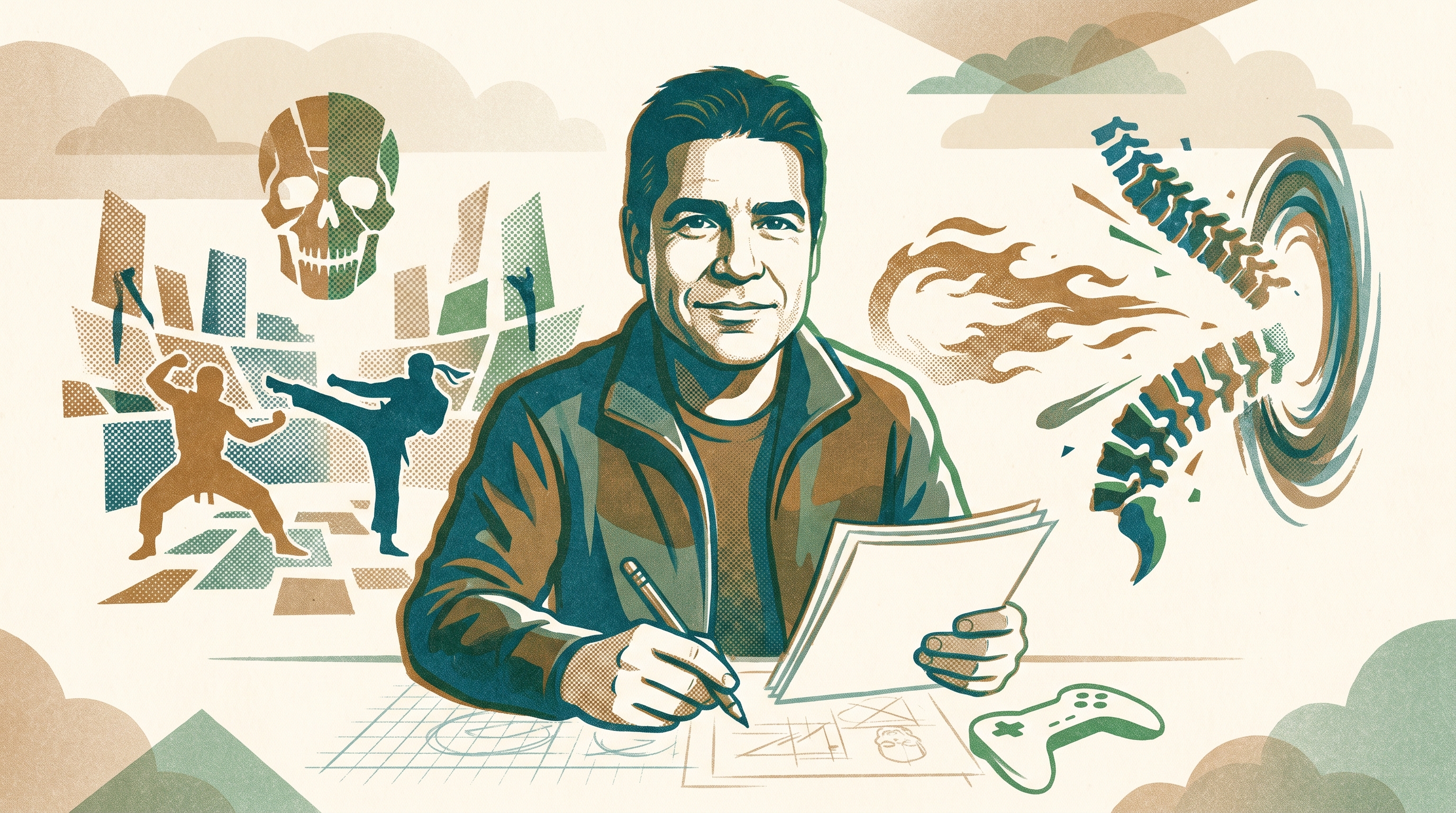
The fatality wasn't cruelty — it was a reward for the player who paid attention.
About
Ed Boon is an American video game programmer, voice actor, and director, born February 22, 1964. He co-created the fighting game series Mortal Kombat with artist John Tobias in 1992 at Midway Games. Boon graduated from the University of Illinois at Urbana-Champaign with a degree in mathematics and computer science. He worked for over 15 years at Midway and has served as Chief Creative Officer at NetherRealm Studios since 2011. He was inducted into the Academy of Interactive Arts & Sciences Hall of Fame in 2022.
History
Edward Boon was born on February 22, 1964. He studied mathematics and computer science at the University of Illinois at Urbana-Champaign, and after graduating joined Williams Entertainment in their pinball department. Over the next two years he worked on approximately twenty pinball games — mechanical machines with rolling steel balls and switches and solenoids — for companies that no longer exist. The skills he learned were precise: timing loops, balancing risk and reward, making a player want one more round. The medium was old, and the craft was not glamorous, but every lesson transferred.
In 1991 Street Fighter II arrived in arcades and changed the stakes. Williams, which owned Midway Games, had been experimenting with digitized graphics of real actors — a technique that allowed them to capture human motion photographically rather than drawing it pixel by pixel. Ed Boon and a young artist named John Tobias proposed a fighting game that would marry that visual innovation to the energy of Street Fighter II. Boon was the programmer; Tobias was the designer. Their pitch originally centered on Jean-Claude Van Damme, the martial arts film star, but the licensing deal fell through. So they built their own world instead.
Development began in earnest in 1991. Four people worked on the game for eight months. The budget was under one million dollars. Boon wrote the code; Tobias designed the characters and story; Dan Forden composed sound and music; John Vogel handled art. They photographed martial artists in the Midway offices and digitized their movements frame by frame. The visual style was not as refined as hand-drawn sprites, but it felt visceral and real in ways other games did not. And they added one element no other fighting game had dared to pursue with such explicit intensity: at the end of a match, if the player input a secret command within a narrow window of time, they could execute a 'Fatality' — a graphic finishing move that ended the opponent in ways that were deliberately theatrical and shocking. The reward was not points. It was spectacle and the pleasure of knowing something most other players did not.
Mortal Kombat was delivered to arcade operators on October 8, 1992. It became a cultural event. Parents and politicians condemned its violence. Players lined up to see what the fuss was about. The controversy fed interest, and interest fed sales. Home console versions for the Sega Genesis and Super Nintendo followed in 1993, with more than six million copies sold across both platforms. The Genesis version preserved the blood; the SNES version replaced it with sweat. Players overwhelmingly preferred the Genesis. Boon had learned what he suspected from the beginning: people wanted the version that did not apologize.
The second game followed with about five people, the third with roughly nine. By the time the franchise reached its later sequels the team had grown to twenty-five, then seventy. Boon remained lead programmer through the 1990s, working alongside Tobias until Tobias left Midway in 2000. After that departure, Boon became the franchise's sole creative steward. He also became the Guinness World Record holder for the longest-serving video game voice actor — he voiced the hidden character Scorpion from the first game onward, including the iconic taunt, 'Get over here!'
When Midway filed for bankruptcy in 2009, Warner Bros. Interactive Entertainment acquired the assets and established NetherRealm Studios in 2010, with Boon as Chief Creative Officer. Under his direction the studio released Mortal Kombat 9 in 2011, a deliberate return to the series' arcade roots after years of experimentation. It sold more than five million copies. He then directed the Injustice series, applying Mortal Kombat's combat design to DC Comics superheroes. Mortal Kombat 11, released in 2019, required four years of development — the longest production cycle in the series' history. Boon explained in interviews that his philosophy had become one of incremental innovation: 'Add something to the fighting, the story, or to the overall experience that's never been done in a Mortal Kombat game, and ideally has never been done in another fighting game or video game.'
In 2009 he was named one of the top 100 game creators of all time by IGN. In 2022 he was inducted into the Academy of Interactive Arts & Sciences Hall of Fame. He has never apologized for the violence. In interviews spanning three decades he has consistently described it not as cruelty but as a choice — a deliberate exaggeration meant to communicate that the game knew it was a game, and that players were in on the joke. The fatality was not designed to disturb. It was designed to reward the player who paid close attention, who learned the secret, who understood that underneath the spectacle was a system with rules. The pinball instincts had never left.
Timeline & Works
Career milestones and all 2 games in the museum they worked on — in the order they happened.
- 1964 02
Born in the United States
Ed Boon is born on February 22, 1964. He later studies mathematics and computer science at the University of Illinois at Urbana-Champaign.
people - 1986
Joins Williams Entertainment pinball department
After graduating from university, Boon joins Williams Entertainment and works on approximately 20 pinball games over the next two years.
people - 1991
Begins developing Mortal Kombat with John Tobias
Boon and artist John Tobias begin developing a fighting game at Midway Games, using digitized actor graphics. The original pitch centered on Jean-Claude Van Damme, but the licensing deal fell through.
product - 1992 10
Mortal Kombat released in arcades
Mortal Kombat is delivered to arcade operators on October 8, 1992. The game, developed by four people over eight months with a budget under one million dollars, becomes a cultural phenomenon due to its graphic violence and secret Fatality finishing moves.
product - 1993
Home console versions sell over 6 million copies
Mortal Kombat is released for Sega Genesis and Super Nintendo. The Genesis version preserves the blood; the SNES version replaces it with sweat. Combined sales exceed six million copies.
product - 1993
- 1995
- 2000
John Tobias leaves Midway; Boon becomes sole creative steward
After John Tobias departs from Midway, Boon becomes the sole creative director of the Mortal Kombat franchise, a role he maintains to the present day.
leadership - 2009
Named one of top 100 game creators by IGN; Midway files bankruptcy
Boon is chosen by IGN as one of the top 100 game creators of all time. The same year, Midway Games files for bankruptcy.
milestone - 2010
NetherRealm Studios founded; Boon becomes Chief Creative Officer
Warner Bros. Interactive Entertainment acquires Midway's assets and establishes NetherRealm Studios, with Ed Boon as Chief Creative Officer.
leadership - 2011
Mortal Kombat 9 released, selling over 5 million copies
Under Boon's direction at NetherRealm Studios, Mortal Kombat 9 is released as a deliberate return to the series' arcade roots. It sells more than five million copies.
product - 2022
Inducted into AIAS Hall of Fame
Ed Boon is inducted into the Academy of Interactive Arts & Sciences Hall of Fame, recognizing his decades-long contributions to the fighting game genre.
milestone
Explore the work
Each title has its own page — history, trivia, and collector's notes.
Rooms their games live in
Sources
- Ed Boon — Wikipedia — accessed 2026-06-22
- The Definitive Interview With Mortal Kombat's Ed Boon — Game Informer — accessed 2026-06-22
- MORTAL KOMBAT Co-Creator Ed Boon on the 27 Year Journey to MK 11 — Nerdist — accessed 2026-06-22
- John Tobias — Wikipedia — accessed 2026-06-22