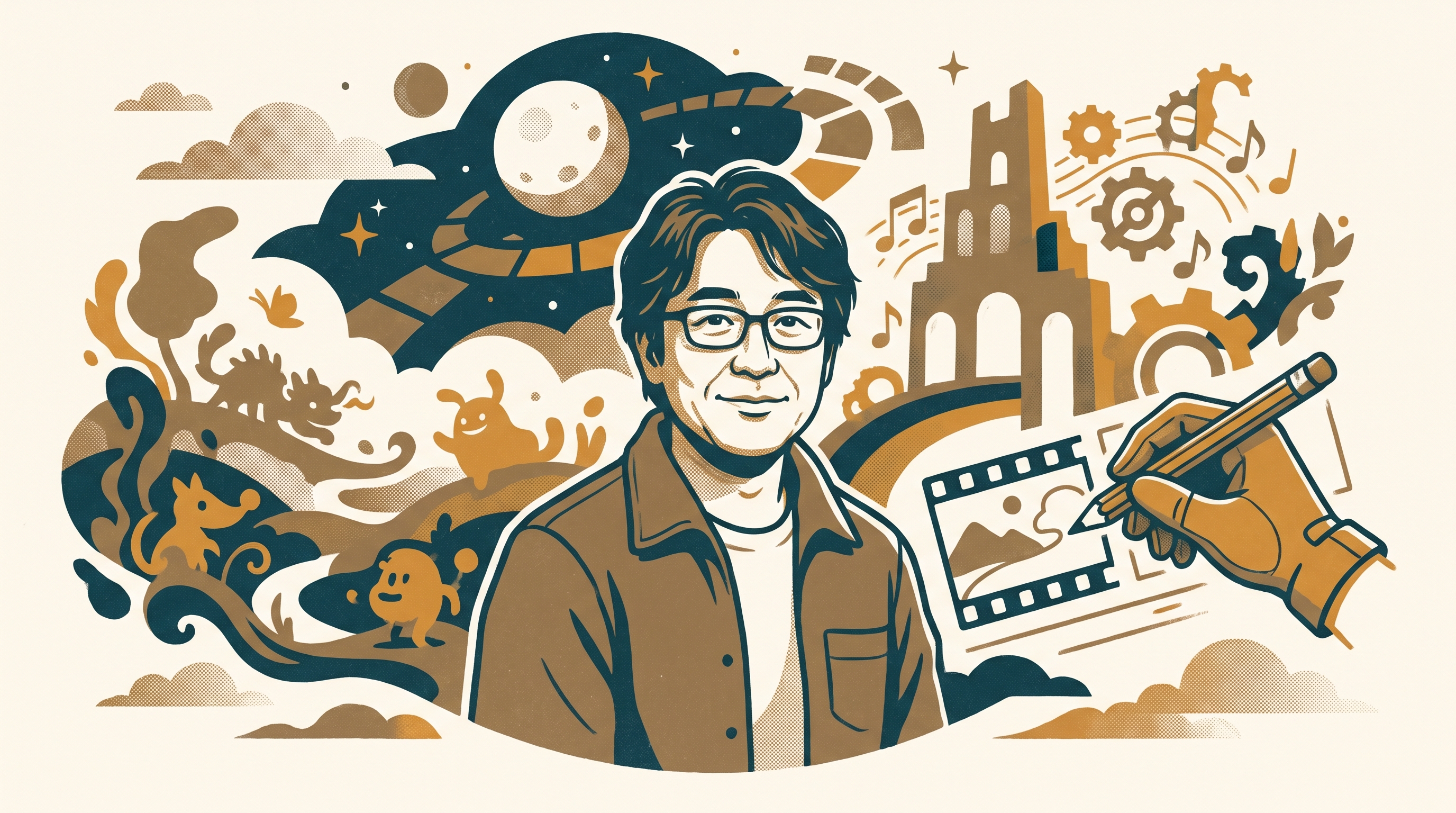
director
Hiroji Kiyotake
清武博二
Don't wait to know everything — start with what you have and let the work teach you. Samus came from someone who didn't yet know how to make her.
About
Hiroji Kiyotake is a Japanese game designer and artist, born December 21, 1960, in Kagoshima Prefecture. He graduated from Kyoto Seika University with a degree in visual design and joined Nintendo Research & Development 1 in 1983. As one of the first designers on the original Metroid, he created Samus Aran's visual design and named her after Pelé (mistakenly believing Pelé's birth name was Samus Arantes rather than Edson Arantes do Nascimento). He later directed Metroid II and Super Mario Land 2, where he co-created Wario. Through the 1990s he directed Wario Land: Super Mario Land 3 and Wario Land II. After Wario Land 4, he transitioned to supervisory roles, overseeing character design within Nintendo's planning and development divisions.
History
Hiroji Kiyotake was born on December 21, 1960, in Kagoshima Prefecture. He studied visual design at Kyoto Seika University, where he joined the rugby club and learned to draw under structured deadlines. When he graduated in 1983, the video game industry was barely a decade old and had no established hiring path for designers. He applied to Nintendo and was accepted into Research & Development 1, the division led by Gunpei Yokoi.
His first major assignment came almost immediately. In 1985 he designed Foreman Spike, the antagonist of Wrecking Crew — a minor character, but a start. The following year, he was pulled into the development of Metroid, a project so understaffed that for long periods the only people working on it were Kiyotake and Yoshio Sakamoto, with no programmer assigned to them. Kiyotake handled the art design for Samus Aran and the planet Zebes's hostile organisms. He chose Samus's name believing it came from the Brazilian footballer Pelé, whose birth name he thought was Samus Arantes. It was actually Edson Arantes do Nascimento. By the time anyone corrected him, the name had already shipped.
The original Metroid released on August 6, 1986. Samus became one of Nintendo's most enduring silhouettes — a figure defined by isolation, competence, and a twist ending that revealed the armored bounty hunter was a woman. Kiyotake had designed her without precedent or template, learning the Famicom's hardware limits as he went. After Metroid, he moved directly to assist with Kid Icarus, credited as an assistant on a project led by others but shaped in part by his athletic sensibility.
In 1991 he directed Metroid II: Return of Samus for the Game Boy. The sequel expanded the original's lonely atmosphere into a descent through increasingly barren caverns, ending with the player exterminating nearly every Metroid in existence — a mission that felt like an ecological collapse. The game sold respectably but was overshadowed by other Nintendo releases that year. Kiyotake's next assignment took him in a completely different direction.
Super Mario Land 2: 6 Golden Coins, released in 1992, needed an antagonist. Kiyotake and the team conceived Wario — a twisted mirror of Mario, greedy where Mario was generous, crude where Mario was polite. The character's exaggerated design and outsized personality made him a breakout, and the following year Kiyotake directed Wario Land: Super Mario Land 3, a game that gave Wario his own series. He followed with Wario Land II in 1998, a Game Boy Color title built around the concept that Wario could not die, only be inconvenienced. The game was well received. It was also Kiyotake's last credited directorial work on a major release.
After Wario Land 4 in 2001, Kiyotake stepped back from direct development. He moved into a supervisory role within Nintendo's Software Planning & Development Division, overseeing character design teams and providing advisory input on how Samus and Wario were depicted in later titles. He did not retire, but his name stopped appearing in credits. The characters he had drawn — one defined by solitude and competence, the other by appetite and bluster — continued to appear in dozens of games over the following decades, their silhouettes unmistakable.
Kiyotake's career is a reminder that some of the sharpest ideas come not from experience but from starting before you know how. He designed Samus as a new graduate who didn't yet understand the hardware he was working with. He created Wario by leaning into exaggeration when restraint was the industry norm. What he made in those early years — learning as he built — outlasted the projects that came later. The work that lasts is often the work you didn't yet know how to make.
Timeline & Works
Career milestones and all 2 games in the museum they worked on — in the order they happened.
- 1960 12
Born in Kagoshima
Born December 21, 1960, in Kagoshima Prefecture, Japan.
people - 1983
Joins Nintendo R&D1
Graduates from Kyoto Seika University with a degree in visual design and joins Nintendo Research & Development 1.
people - 1985
Designs Foreman Spike
Designs Foreman Spike (Blacky in Japan), the antagonist of Wrecking Crew — his first credited character work at Nintendo.
product - 1986 08
Metroid releases — designs Samus Aran
The original Metroid releases on August 6, 1986. Kiyotake designed Samus Aran and named her after Pelé (mistakenly believing Pelé's birth name was Samus Arantes).
product - 1991
Directs Metroid II
Directs Metroid II: Return of Samus for Game Boy, a sequel built around ecological collapse and isolation.
product - 1992
Co-creates Wario
Super Mario Land 2: 6 Golden Coins releases; Kiyotake co-creates Wario as a twisted mirror of Mario.
product - 1992
- 1993
Directs Wario Land
Directs Wario Land: Super Mario Land 3, giving Wario his own series.
product - 1994
- 1998
Directs Wario Land II
Directs Wario Land II for Game Boy Color, a game built around the concept that Wario cannot die.
product - 2001
Transitions to supervisory role
After Wario Land 4, steps back from direct development and moves into supervisory roles overseeing character design at Nintendo.
leadership
Connections
- employed nintendo-rd1 (1983–2001)
Joined Nintendo R&D1 in 1983 as a fresh graduate; designed Samus and directed early Metroid/Wario titles before transitioning to supervisory roles.
- collaborated with yoshio-sakamoto (1986–present)
Worked alongside Yoshio Sakamoto on the original Metroid, often as the only two people assigned to the project for long stretches.
Also connected to
- Gunpei Yokoi co-created Metroid / same employer (Nintendo R&D1, 1983–1996)
- Kozue Ishikawa co-created Wario Land: Super Mario Land 3 / same employer (Nintendo R&D1, 1994–2000)
- Hirokazu Tanaka co-created Metroid
- Kazumi Totaka co-created Super Mario Land 2: 6 Golden Coins
Explore the work
Each title has its own page — history, trivia, and collector's notes.
Rooms their games live in
Sources
- Hiroji Kiyotake — Wikipedia — accessed 2026-06-23
- Hiroji Kiyotake — Nintendo Wiki — accessed 2026-06-23
- Making of a Myth: The Grueling Development of the Original Kid Icarus — Nintendo World Report — accessed 2026-06-23
- Metroid Developers Reflect on the Development Process — Nintendo Life — accessed 2026-06-23
- やればやるほど ディスクシステム インタビュー — Nintendo DREAM WEB — accessed 2026-06-23