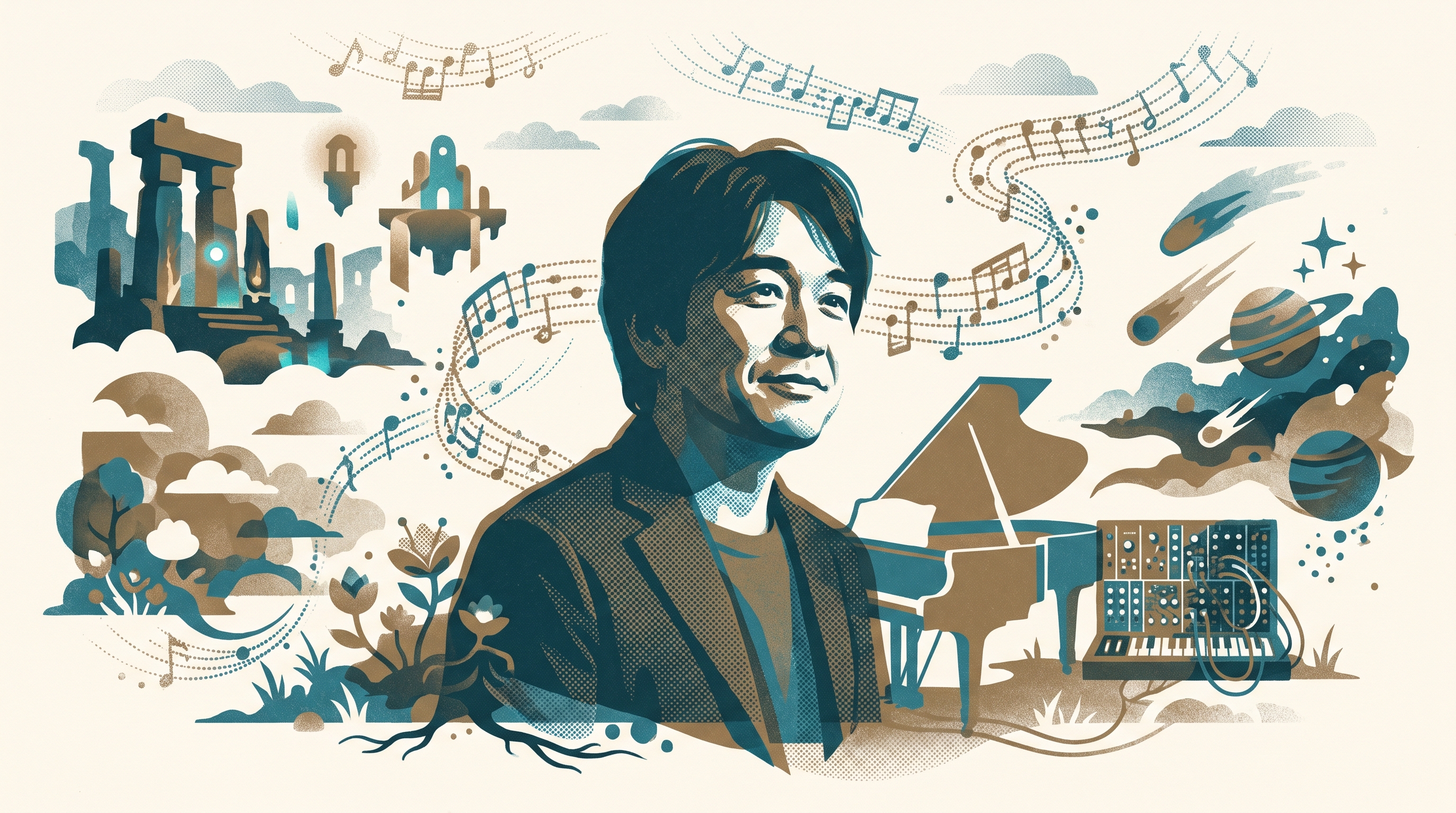
composer
Jun Funahashi
船橋潤
He built sound drivers, wrote half a soundtrack, and left no interviews — the constraint was the story.
About
Jun Funahashi is a Japanese composer who worked for Konami from the mid-1980s through approximately 2000. Also known by the aliases Dog-Man and J.Funahashi, he was a member of the Konami Kukeiha Club and contributed to improving Konami's NES sound driver while composing music for several notable titles including Teenage Mutant Ninja Turtles (NES), Castlevania III: Dracula's Curse, and Castlevania: Rondo of Blood. Around 2000 he transitioned to become music director for Konami Computer Entertainment Hawaii, Inc.
History
Jun Funahashi joined Konami in the mid-1980s when the Famicom sound chip was still a frontier. Composers at that time were not simply musicians — they were also engineers, writing low-level code to coax usable sounds from hardware that had never been designed for music in the first place. Funahashi, who used the aliases Dog-Man and J.Funahashi in game credits, became known internally not only for composing but for helping improve Konami's NES sound driver itself — the software layer that all other composers at the company would rely on. He was part of the Konami Kukeiha Club, an informal collective of Konami sound staff whose name translates roughly to 'Konami Rectangle Wave Club,' a wry nod to the square-wave oscillators that formed the backbone of 8-bit sound.
In 1989 Funahashi composed roughly half of the soundtrack for Teenage Mutant Ninja Turtles on the NES, a game that became notorious among players for its difficulty but was equally notable for its musical identity. In later recollections he acknowledged the collaborative nature of the work but noted that after so many years he could not recall which other composers had contributed. The same year he also composed music for Racer Mini Yonku: Japan Cup, a Famicom board-racing game released on August 25, 1989. These were workmanlike projects — commercial assignments made under tight schedules — but they demonstrated a composer who understood how to build atmosphere within extreme technical constraint.
His most recognized work came in the form of two Castlevania titles. For Castlevania III: Dracula's Curse — known in Japan as Akumajō Densetsu — Funahashi co-composed the soundtrack alongside Hidenori Maezawa and Yukie Morimoto. The Japanese Famicom version of the game contained a specialized sound chip, the Konami VRC6, which added two additional pulse-wave channels and a sawtooth wave channel to the standard Famicom audio output. This allowed for richer harmonic arrangements and more elaborate musical compositions than the NES could produce on its own. The North American release in 1990 used the standard NES hardware, and the music was adapted accordingly — the same compositions, stripped down to fit within the narrower palette. Funahashi's contribution to that score became part of one of the most musically ambitious 8-bit games ever released.
In 1993 Funahashi contributed to Castlevania: Rondo of Blood (Akumajo Dracula X: Chi no Rondo), a TurboGrafx-CD title that moved from chip-based synthesis to CD-quality streamed audio. The shift in technology was dramatic: from programming waveforms in assembly code to arranging recorded instruments. The game's soundtrack, composed by multiple members of the Konami sound team, became one of the defining works of the PC Engine CD-ROM² library. Between these two Castlevania projects Funahashi also worked on Contra Force, released for the NES in 1992.
Around the year 2000 Funahashi transitioned out of direct composition work and became the music director for Konami Computer Entertainment Hawaii, Inc., a subsidiary studio focused primarily on licensed sports titles and regional projects. The role moved him from the creation of music to its oversight and direction — a shift that many veteran game composers eventually make as studios grow and production pipelines formalize. After this point, public information about his career becomes sparse. He gave no known interviews, left no retrospective statements, and his name disappeared from game credits.
Jun Funahashi's career is a case study in the invisible labor that built the foundation of game music. He improved the tools, wrote the notes, collaborated without attribution, and moved on when the work changed. The music he helped create — especially the VRC6 arrangements for Castlevania III — remains studied and remixed by enthusiasts decades later, but the man himself chose to leave no narrative behind. What remains is the sound: disciplined, atmospheric, built to function under constraint. In an industry where fame often follows those who speak loudest about their process, Funahashi's legacy is the rarer kind — one built entirely from the work itself.
Timeline & Works
Career milestones and all 2 games in the museum they worked on — in the order they happened.
- 1985
Joins Konami as composer and sound engineer
Funahashi joins Konami in the mid-1980s, becoming part of the Konami Kukeiha Club and contributing to improvements in the company's NES sound driver while also composing music for games.
people - 1989
Castlevania III: Dracula's Curse (Japan) — VRC6 soundtrack
Co-composes the soundtrack for Akumajō Densetsu (Castlevania III: Dracula's Curse) alongside Hidenori Maezawa and Yukie Morimoto. The Japanese Famicom version uses the Konami VRC6 sound chip, enabling richer harmonic arrangements than the standard NES.
product - 1989
Teenage Mutant Ninja Turtles (NES) soundtrack — half composed by Funahashi
Funahashi composes approximately half of the soundtrack for Konami's Teenage Mutant Ninja Turtles on the NES. The game becomes known both for its difficulty and its distinctive musical atmosphere.
product - 1989 08
Racer Mini Yonku: Japan Cup released
Funahashi composes music for Racer Mini Yonku: Japan Cup, a Famicom board-racing game released on August 25, 1989.
product - 1989
- 1989
- 1990
Castlevania III: Dracula's Curse (North America) released
The North American version of Castlevania III is released using standard NES hardware. The VRC6-enhanced music is adapted to fit the narrower audio palette of the base system.
product - 1992
Contra Force (NES) soundtrack
Funahashi composes music for Contra Force, released for the NES in 1992.
product - 1993
Castlevania: Rondo of Blood (TurboGrafx-CD)
Contributes to the soundtrack of Castlevania: Rondo of Blood (Akumajo Dracula X: Chi no Rondo) for the TurboGrafx-CD. The game shifts from chip-based synthesis to CD-quality streamed audio, marking a significant technological transition.
product - 2000
Becomes music director at Konami Computer Entertainment Hawaii
Around 2000, Funahashi transitions from direct composition work to become music director for Konami Computer Entertainment Hawaii, Inc., overseeing music production for the subsidiary studio.
leadership
Connections
- employed konami (1985–2000)
Funahashi worked for Konami from the mid-1980s through approximately 2000, composing music and improving the company's NES sound driver as part of the Konami Kukeiha Club.
Also connected to
- Hidenori Maezawa co-created Castlevania III: Dracula's Curse / same employer (Konami, 1986–1995)
Explore the work
Each title has its own page — history, trivia, and collector's notes.
Family Computer (Famicom) / NES · 1989
Castlevania III: Dracula's Curse
Alucard first appeared here as a playable ally. He would not return until Sympho…
Family Computer (Famicom) / NES · 1989
Teenage Mutant Ninja Turtles
Konami's Turtles on Famicom. Difficult, non-linear, and the first TMNT console g…
Rooms their games live in
Sources
- Jun Funahashi - Video Game Music Preservation Foundation Wiki — accessed 2026-06-19
- Akumajō Densetsu / Castlevania III Soundtrack - Internet Archive — accessed 2026-06-19
- Teenage Mutant Ninja Turtles (NES) - Video Game Music Preservation Foundation Wiki — accessed 2026-06-19
- Artist: Jun Funahashi [Composer] - OC ReMix — accessed 2026-06-19
- Castlevania III: Dracula's Curse - Wikipedia — accessed 2026-06-19