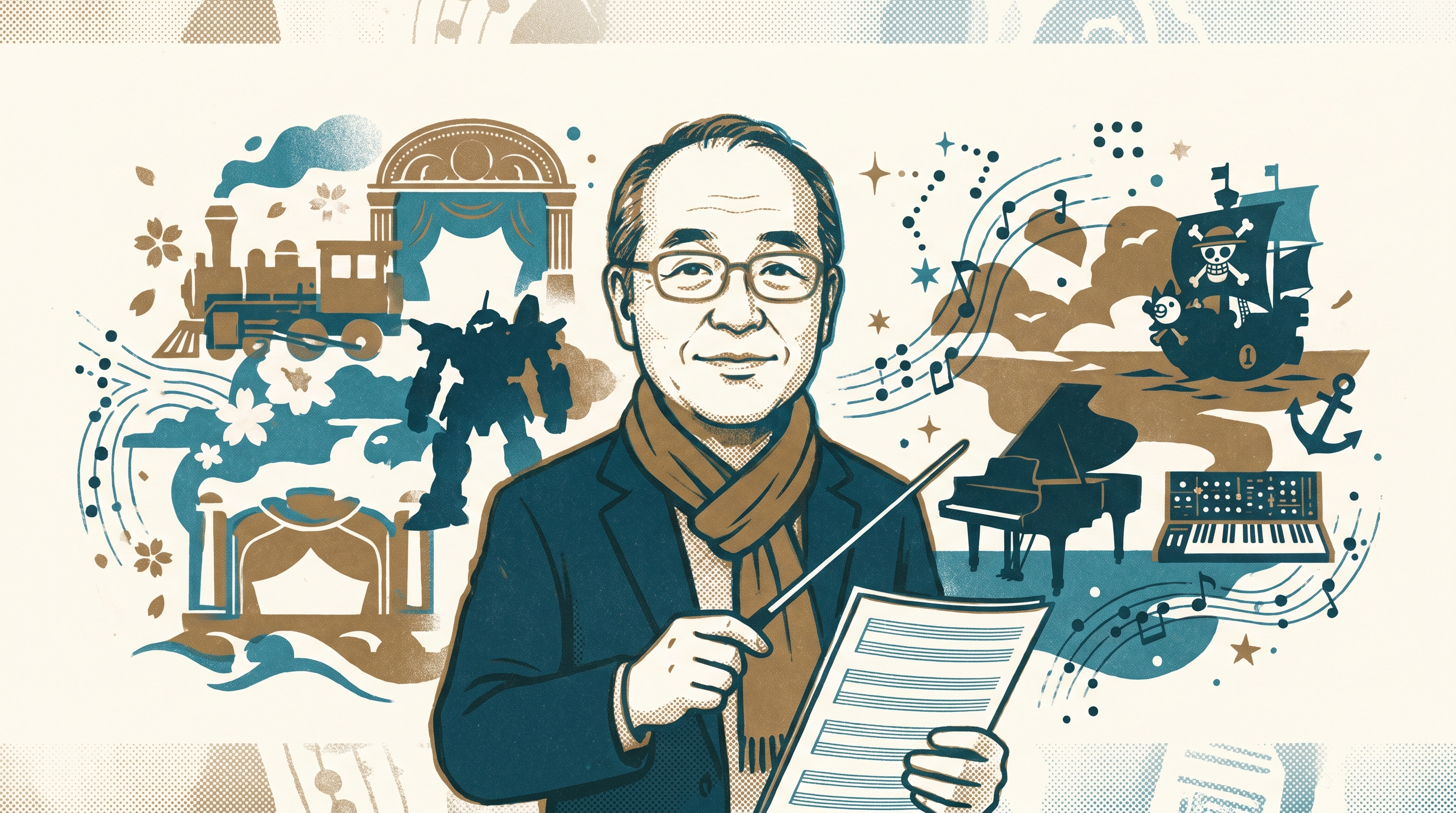
composer
Kohei Tanaka
田中公平
He wrote 'Geki Teikoku Kagekidan' in fifteen minutes — proof that the best ideas don't always ask for more time, just the right moment.
About
Kohei Tanaka is a Japanese composer, arranger, conductor and singer-songwriter, born February 14, 1954 in Osaka. He graduated from Tokyo University of the Arts and studied at Berklee College of Music. While working as a hotel lounge pianist in 1982, he was asked to arrange a song for the anime Arcadia of My Youth: Endless Orbit SSX — his first work as a composer. He has since created musical scores for over 8,000 songs across anime, video games, and tokusatsu series, including Sakura Wars, Gunbuster, One Piece, The King of Braves GaoGaiGar, and Mobile Fighter G Gundam.
History
Kohei Tanaka was born on February 14, 1954, in Osaka, Japan. He grew up in a household where music was present but not mandated. His path to composition was not preordained. He entered Tokyo University of the Arts to study composition, then traveled to the United States to attend Berklee College of Music. By the early 1980s, he was back in Japan, playing piano in a hotel lounge. The work was steady but unremarkable. He was not waiting for a career in music. He was simply making a living.
In 1982, while employed at that lounge, someone asked him to arrange a song for a television anime series called Arcadia of My Youth: Endless Orbit SSX. It was a small request. He accepted it. That arrangement became his entry into the world of composition for visual media. The opening was narrow — a single arrangement, unpaid fanfare, no guarantees. But the door stayed open. Work came in pieces: one project, then another, then a few more. By the mid-1980s, he was composing regularly for anime and tokusatsu series.
His musical signature emerged across projects that lived at the intersection of heroism and sentiment. Gunbuster in 1988 gave him space to write operatic grandeur for a story about young pilots facing annihilation. Mobile Fighter G Gundam in 1994 asked for blood-pumping tournament music, and he delivered themes that felt like fists raised in defiance. The King of Braves GaoGaiGar in 1997 became an anthem of courage wrapped in orchestral bombast. These were not background scores. They were active participants in the drama, carrying emotion the images could not.
In 1996, he was brought on to compose music for Sakura Wars, a game blending tactical battles with theatrical romance, set in a Taishō-era steampunk Tokyo. The project called for something operatic yet accessible — music that could sound like a stage revue one moment and a military march the next. He wrote the main theme, 'Geki! Teikoku Kagekidan,' in roughly fifteen minutes. The story of that speed has been told and retold, sometimes with wonder, sometimes with skepticism. Tanaka himself has confirmed it in interviews: the melody arrived quickly, fully formed. The song became the franchise's heartbeat, performed live at concerts, sung by voice actors, embedded in the opening of every Sakura Wars entry for a quarter-century.
The success of Sakura Wars did not make him famous in the Western sense, but within anime and game music circles in Japan, his name carried weight. He went on to compose for One Piece starting in 1999, creating over a thousand pieces of music across two decades for a show that never stopped airing. His output was not just prolific but relentless: over 8,000 songs and background music pieces across his career, spanning genres, moods, and formats. He did not specialize in one emotion. He ranged freely — heroic fanfares, melancholy ballads, comedic stings, tragic adagios.
He has spoken openly, in interviews and public talks, about the craft of writing music that serves a story rather than standing apart from it. His philosophy is functional: music is not decoration, it is structure. It holds scenes together. It tells the audience what to feel when the images are ambiguous. It gives characters a voice when they have none. This is not a romantic view of composition. It is a practical one. He approaches each project as a problem to be solved, not a canvas to be painted.
Tanaka's career is a case study in what happens when someone takes a narrow opening and refuses to treat it as a fluke. One arrangement led to a second project, which led to a franchise, which led to a lifetime of work. He did not wait for inspiration to arrive on schedule. He worked, consistently, and let the volume of output create its own opportunities. The fifteen-minute melody became a legend not because it was fast, but because it worked — and because he kept working after it.
Timeline & Works
Career milestones and all 3 games in the museum they worked on — in the order they happened.
- 1954 02
Born in Osaka
Born February 14, 1954 in Osaka, Japan.
people - 1982
First work as composer
While working as a hotel lounge pianist, he was asked to arrange a song for the anime 'Arcadia of My Youth: Endless Orbit SSX' — his first work as a composer.
milestone - 1988
Gunbuster
Composed the music for the OVA series Gunbuster, establishing his signature style of operatic grandeur.
product - 1994
Mobile Fighter G Gundam
Composed music for Mobile Fighter G Gundam, delivering blood-pumping tournament themes.
product - 1996
Sakura Wars and 'Geki Teikoku Kagekidan'
Composed music for Sakura Wars. Wrote the main theme 'Geki! Teikoku Kagekidan' in roughly fifteen minutes. The song became the franchise's heartbeat for a quarter-century.
product - 1996
- 1997
The King of Braves GaoGaiGar
Composed music for The King of Braves GaoGaiGar, creating an anthem of courage wrapped in orchestral bombast.
product - 1997
- 1998
- 1999
One Piece
Began composing for the anime One Piece, creating over 1,000 pieces of music across two decades.
product - 2014
40th anniversary as composer
Celebrated 40 years as a composer, having created over 8,000 songs and background music pieces.
milestone - 2021
Sakura Wars 25th anniversary concert
Conducted the Sakura Wars 25th anniversary orchestra concert, celebrating his work on the franchise and his 40+1 years as a composer.
milestone
Explore the work
Each title has its own page — history, trivia, and collector's notes.
Sega Saturn · 1998
Dragon Force II: Kamisarishi Daichi ni
The Saturn-exclusive sequel. Bigger armies, more characters, and a strategy RPG …
PlayStation · 1997
Alundra
A dream-walker who enters the nightmares of dying villagers. Matrix Software's a…
Sega Saturn · 1996
Sakura Wars
A strategy RPG where you ran a theater company in 1920s Tokyo and fell in love b…
Rooms their games live in
Sources
- Kohei Tanaka - Wikipedia (English) — accessed 2026-06-19
- 田中公平 — ニコニコ大百科 — accessed 2026-06-19
- 田中公平:愛され続ける名曲「ゲキテイ」 舞台「新サクラ大戦」に愛を込めて — MANTANWEB — accessed 2026-06-19
- 田中公平氏インタビュー:舞台「新サクラ大戦 the Stage 〜二つの焔〜」と「サクラ大戦」への思い,そして作曲家としての生き方 — 4Gamer.net — accessed 2026-06-19
- 作曲家歴40周年・田中公平氏ロングインタビュー。『サクラ大戦』&『グラビティデイズ』の裏話から、『ジョジョ』のあの名曲の秘話まで! — ファミ通 — accessed 2026-06-19
- Kohei Tanaka | Sakura Wars Wiki | Fandom — accessed 2026-06-19