designer
Masanobu Endo
遠藤雅伸
One person, one game, one year. When you need permission from no one, you can build a world alone.
About
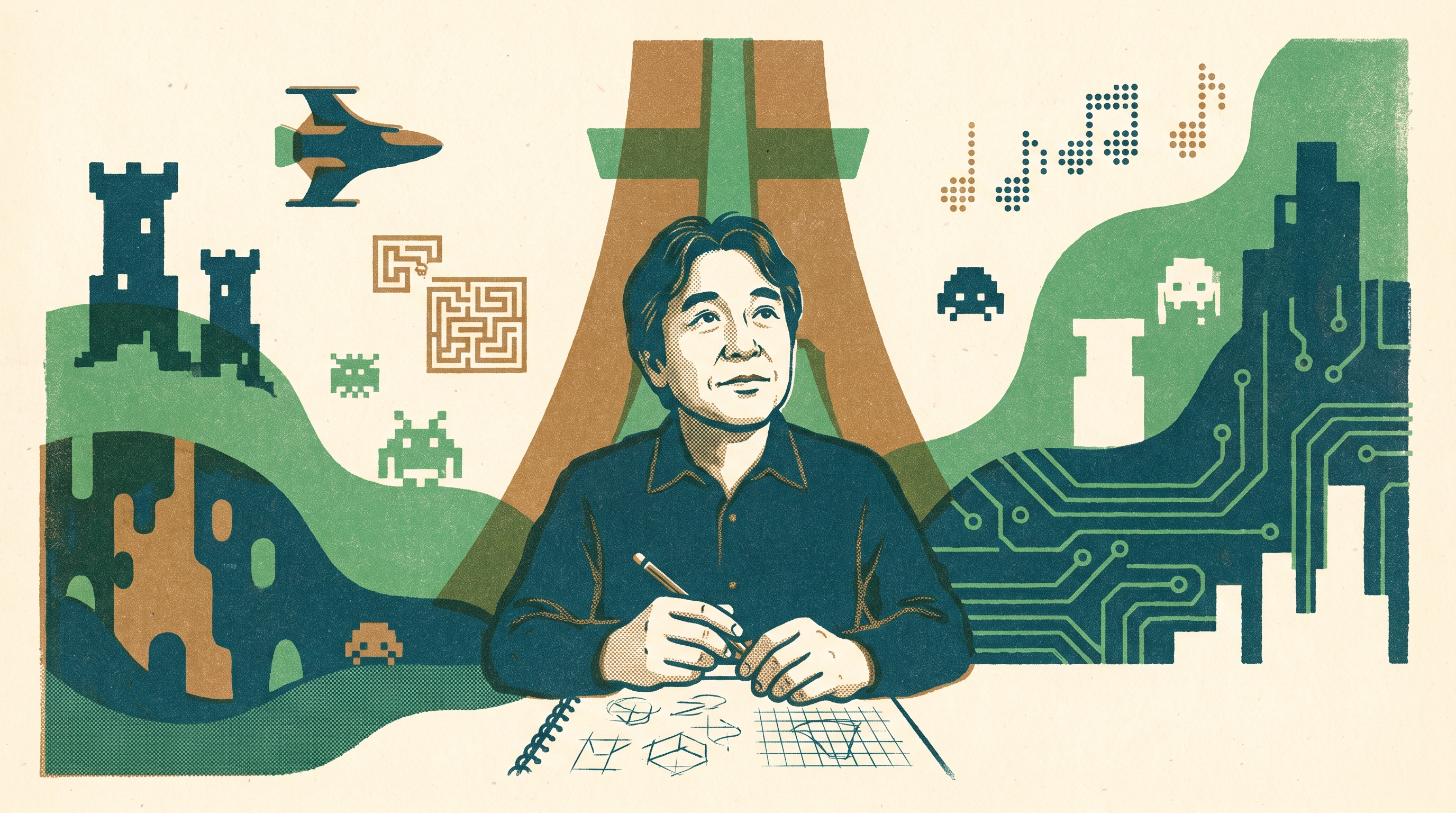
Masanobu Endo is a Japanese game designer born February 23, 1959. He joined Namco in 1981 and in 1982 created Xevious, single-handedly designing, programming, and drawing the graphics for the game. The vertical scrolling shooter became a cultural phenomenon in Japan. In 1984 he designed The Tower of Druaga, an early action role-playing game that influenced the genre for decades. He founded Game Studio in 1985 and has been called the "god of games" in Japan.
History
Masanobu Endo was born on February 23, 1959, in Tokyo. He studied information and image science at Chiba University, graduating in 1981. That same year, he joined Namco, one of Japan's leading arcade game developers. He was twenty-two years old. The company assigned him to the development division. He was given a project almost immediately.
In 1982, Endo was tasked with creating a new vertical scrolling shooter. He worked alone. He designed the game, wrote the code, and drew every sprite by hand. The result was Xevious, a game set in a hostile alien landscape where the player controlled a fighter craft called the Solvalou. The game featured two weapon types — an air-to-air zapper and a ground-bombing blaster — requiring the player to manage threats on two planes simultaneously. For its time, the graphics were detailed and atmospheric, creating a sense of place that was rare in arcade games.
Xevious was released in January 1983 and became a cultural phenomenon in Japan. It dominated arcades for months. Players memorized hidden targets, secret bonus areas, and the layout of every stage. Fans produced hand-drawn maps and shared strategies in gaming magazines. The game sold over 100,000 arcade cabinets in Japan alone. Endo, who had been an unknown developer a year earlier, was suddenly a public figure. He did interviews. He gave talks. He was called a genius. He was twenty-three years old.
In 1984, Endo designed The Tower of Druaga, an action role-playing game in which players climbed a sixty-floor tower, battling enemies and uncovering hidden treasures on each floor. The game required exploration, trial, and memory — players had to discover the conditions for making items appear, and those conditions were often cryptic. The Tower of Druaga became a template for action RPGs in Japan, influencing games like The Legend of Zelda and Ys. It was a different kind of challenge from Xevious, but it carried the same signature: a world built with care, inviting players to inhabit it fully.
In 1985, Endo left Namco and founded Game Studio, an independent development company. He continued to design games across multiple genres, working on projects ranging from puzzle games to RPGs. He also became an educator, teaching game design and researching player behavior. In 2015, he earned a doctorate in engineering for his work on game design theory. He has served as the director of the Digital Games Research Association Japan and has remained an active voice in the industry.
Endo's career began at a moment when it was still possible for one person to build an entire game alone — to design it, code it, and draw it. That era did not last long. Teams grew larger. Development became specialized. But for one year, in 1982, a twenty-three-year-old designer sat at a desk and built a world by himself. Millions of people played it. That world is still remembered.
Timeline & Works
Career milestones and all 2 games in the museum they worked on — in the order they happened.
- 1959 02
Born in Tokyo
Masanobu Endo was born on February 23, 1959, in Tokyo, Japan.
people - 1981
Joins Namco
Endo graduates from Chiba University and joins Namco as a game developer.
people - 1983 01
Xevious released
Xevious is released in arcades and becomes a cultural phenomenon in Japan, selling over 100,000 cabinets. Endo designed, programmed, and drew all graphics alone.
product - 1984
The Tower of Druaga released
Endo designs The Tower of Druaga, an early action RPG that became a template for the genre and influenced later games like The Legend of Zelda.
product - 1984
- 1985
Founds Game Studio
Endo leaves Namco and founds Game Studio, an independent game development company.
people - 1985
- 2015
Earns doctorate in engineering
Endo is awarded a doctorate in engineering for his research on game design theory and player behavior.
milestone
Connections
- employed namco (1981–1985)
Endo joined Namco in 1981 and created Xevious and The Tower of Druaga before leaving to found his own company in 1985.
Explore the work
Each title has its own page — history, trivia, and collector's notes.
Rooms their games live in
Sources
- Masanobu Endō — Wikipedia — accessed 2026-06-22
- 遠藤雅伸 — Wikipedia — accessed 2026-06-22
- Masanobu Endo x Shigeru Miyamoto – 1986 Interview — accessed 2026-06-22
- Masanobu Endo x Shigesato Itoi – 1985 Interview — accessed 2026-06-22
- プレイヤーの振る舞いを研究し、ゲームデザインに活かす~遠藤雅伸氏・博士号取得記念インタビュー — accessed 2026-06-22