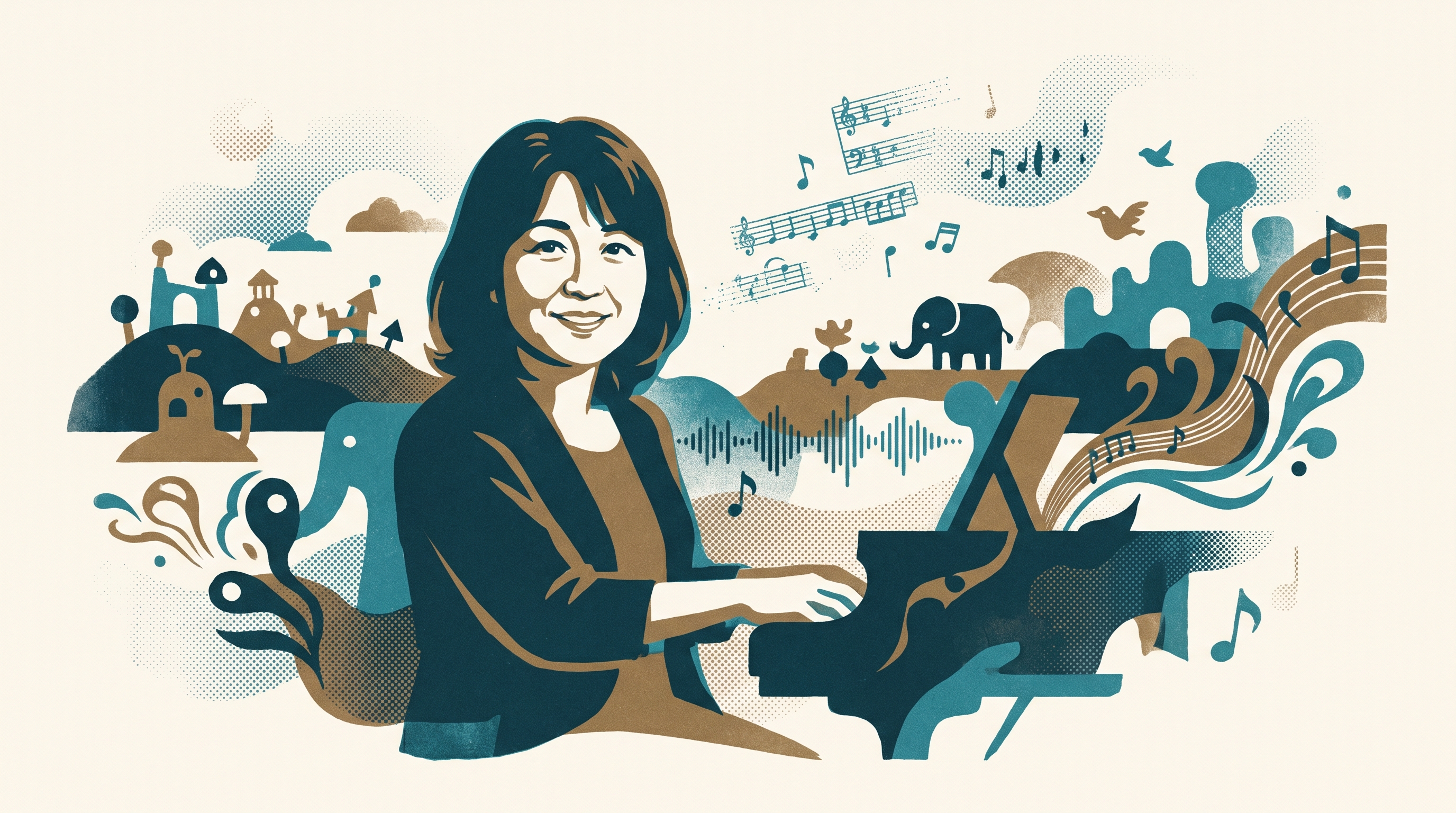
composer
Minako Hamano
浜野美奈子
She wrote the theme that plays when a predator appears in silence — proof that what you don't hear can be as important as what you do.
About
Minako Hamano is a Japanese video game composer born June 28, 1969 in Kyoto. She joined Nintendo's R&D1 department in 1991, with her debut work on The Legend of Zelda: Link's Awakening and Super Metroid. She is primarily known for her contributions to the Metroid series alongside Kenji Yamamoto, and is the longest-tenured female composer at Nintendo.
History
Minako Hamano was born June 28, 1969 in Kyoto City. She joined Nintendo's R&D1 department in 1991, straight into one of the most respected sound teams in the industry. Her first assignments were The Legend of Zelda: Link's Awakening and Super Metroid — both released in 1993 and 1994 respectively. For a debut, that was not a gentle introduction. It was being handed two of the company's most important franchises and told to write music that would define them.
For Link's Awakening, she composed the "Ballad of the Wind Fish," a melody so central to the game that the story could not exist without it. In Super Metroid, working alongside Kenji Yamamoto, she wrote Ridley's theme — the sound of a predator circling in the dark. What distinguished her work was not volume or complexity, but restraint. She understood that in a world of isolation and suspense, silence could carry as much weight as sound.
When Metroid Fusion arrived in 2002, Hamano was the sole composer. Kenji Yamamoto was not involved this time; instead, she collaborated with Akira Fujiwara. The game's music was marked by a colder, more clinical tone — fitting for a story about an organism that wears your face and hunts you through sterilized corridors. She composed the SA-X Appears track, which plays when the parasite mimicking Samus steps into view. It is not loud. It does not announce itself. It simply arrives, and the player knows what it means.
Throughout the 2000s and 2010s, Hamano's role gradually shifted. She contributed to Donkey Kong Country Returns, Donkey Kong Country: Tropical Freeze, and the Brain Age series. But more often, she worked as a sound coordinator — supervising audio for games developed externally, ensuring consistency in Nintendo's sound identity across projects handled by outside studios. The work was less visible than composing a lead theme, but it was structural. Someone had to hold the center.
As of this writing, Hamano is the longest-employed female composer at Nintendo. That is not a small fact. The game industry, particularly in the 1990s, was not built to retain women in creative roles for decades. Many left. She stayed. Her career spans over thirty years, from the Game Boy to the Switch era, from monophonic beeps to orchestral arrangements. She has seen the tools change completely, but the principle remains: the music serves the world, not the other way around.
What Hamano's work demonstrates is that longevity in a creative field is not about chasing trends or making yourself indispensable through spectacle. It is about understanding what the work needs and being able to deliver it, year after year, across hardware generations and shifting team structures. The Ballad of the Wind Fish still plays. Ridley's theme still unsettles. The SA-X still steps into frame without warning. She wrote sounds that do not age because they were never about the present — they were about the feeling underneath.
Timeline & Works
Career milestones and all 5 games in the museum they worked on — in the order they happened.
- 1969 06
Born in Kyoto
Minako Hamano was born on June 28, 1969 in Kyoto City.
people - 1991
Joined Nintendo R&D1
Hamano joined Nintendo's Research & Development 1 department, one of the most respected sound teams in the industry.
people - 1993
Debut: The Legend of Zelda: Link's Awakening
Composed music for Link's Awakening, including the iconic "Ballad of the Wind Fish." Released June 6, 1993 in Japan.
product - 1993
- 1994
Super Metroid
Co-composed Super Metroid with Kenji Yamamoto, including Ridley's theme. Released March 19, 1994 in Japan.
product - 1994
- 1998
- 2002
Metroid Fusion (sole composer)
Served as the sole composer for Metroid Fusion, collaborating with Akira Fujiwara. Notable for the SA-X Appears track. Released November 17, 2002 in Japan.
product - 2002
- 2003
- 2010
Donkey Kong Country Returns
Contributed music to Donkey Kong Country Returns, developed by Retro Studios. Released December 9, 2010 in Japan.
product - 2014
Donkey Kong Country: Tropical Freeze
Worked on Donkey Kong Country: Tropical Freeze as composer and sound coordinator. Released February 13, 2014 in Japan.
product - 2021
Over 30 years at Nintendo
Hamano became the longest-employed female composer at Nintendo, spanning from Game Boy to Switch era.
milestone
Connections
- employed nintendo (1991–present)
Joined Nintendo R&D1 in 1991 and remains the longest-tenured female composer at the company.
- collaborated with kenji-yamamoto-metroid (1994–present)
Long-time musical partner in the Metroid series, co-composing Super Metroid and other titles.
Also connected to
- Yoshio Sakamoto co-created Metroid Fusion / co-created Super Metroid / co-created Super Metroid / same employer (Nintendo, since 1991)
- Shigeru Miyamoto co-created The Legend of Zelda: Link's Awakening DX / co-created The Legend of Zelda: Link's Awakening / same employer (Nintendo, since 1991)
- Kazumi Totaka co-created The Legend of Zelda: Link's Awakening DX
- Kozue Ishikawa co-created The Legend of Zelda: Link's Awakening DX
Explore the work
Each title has its own page — history, trivia, and collector's notes.
Nintendo GameCube · 2003
Wario World
Treasure made a Wario action game for GameCube. Punch, grab, throw, and smash th…
Game Boy Advance · 2002
Metroid Fusion
Samus wiped out the Metroids in Super Metroid. That extinction freed the X Paras…
Game Boy Color · 1998
The Legend of Zelda: Link's Awakening DX
The dream was real — every farewell on Koholint Island was.…
Super Famicom / SNES · 1994
Super Metroid
She didn't pull the trigger then. And that small mercy came back to save her.…
Game Boy · 1993
The Legend of Zelda: Link's Awakening
No Hyrule. No Triforce. No Zelda. And nothing before it or since has asked the s…
Rooms their games live in
Sources
- Minako Hamano - Nintendo Wiki — accessed 2026-06-18
- Minako Hamano - Super Mario Wiki — accessed 2026-06-18
- Minako Hamano - Wikitroid — accessed 2026-06-18
- Minako Hamano: 50th Birthday Tribute - Shinesparkers — accessed 2026-06-18
- Minako Hamano - Video Game Music Preservation Foundation — accessed 2026-06-18