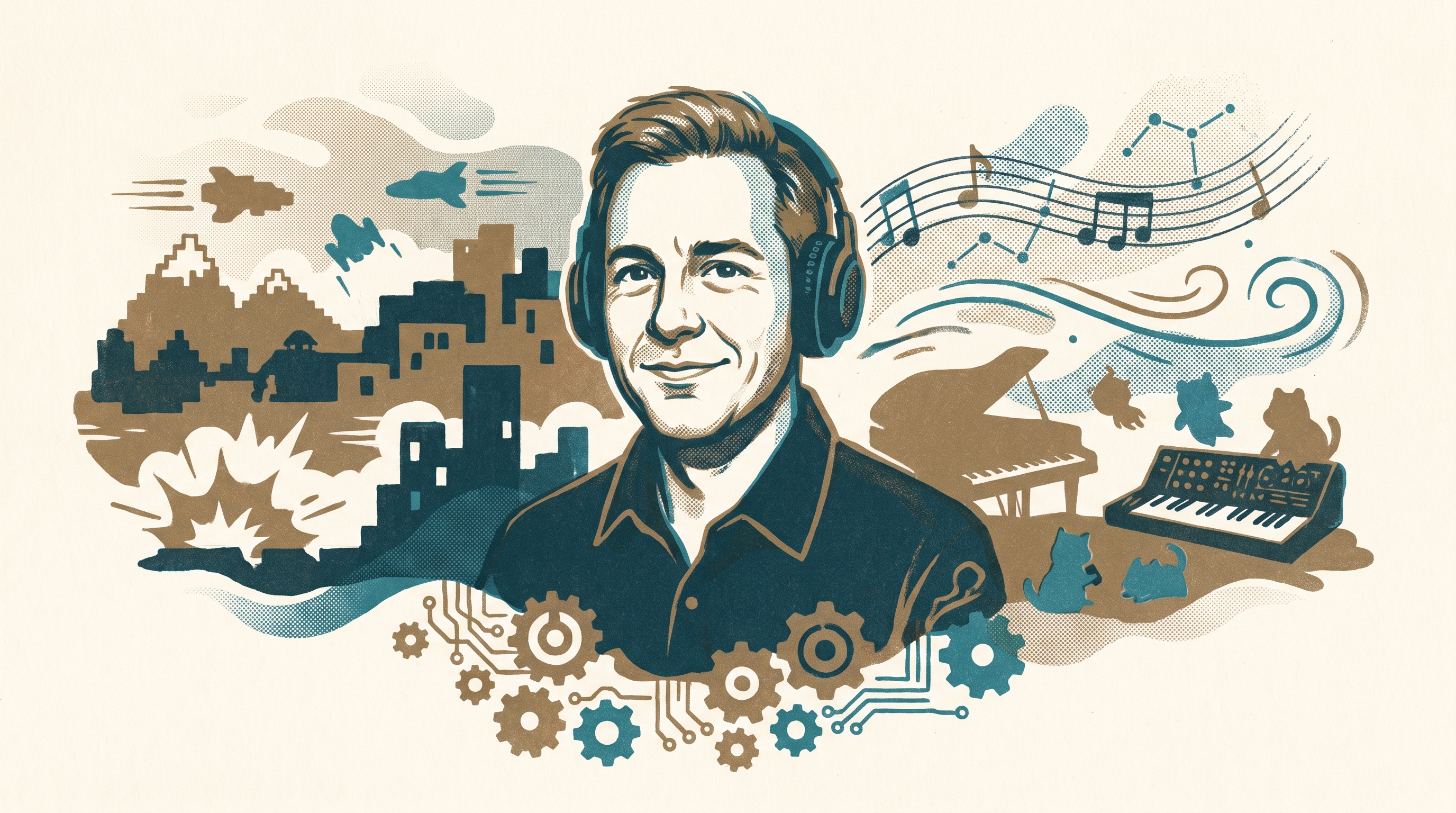
composer
Sonic Mayhem
ソニック・メイヘム
He sent a tape to id Software and they said yes. The rest was twenty years of proving no one else sounds like this.
About
Sonic Mayhem is the professional name of Sascha Dikiciyan, a German-born, Los Angeles-based video game composer and sound designer. Born in Stuttgart and raised in Berlin, he moved to Los Angeles in 1993 and studied at the Musicians Institute. In 1997, id Software commissioned him to score Quake II after he sent them his alternate Quake soundtrack Methods of Destruction. That industrial-electronic score defined the Sonic Mayhem sound and launched a decades-long career across Mass Effect 3, Deus Ex: Mankind Divided, Borderlands, God of War 2, Mortal Kombat, and over 45 game projects.
History
Sascha Dikiciyan was born in Stuttgart, Germany, in 1970. He grew up in Berlin during the early wave of European electronic music, learning piano as a child before switching to drums at twelve. The landscape around him — Tangeline Dream, Kraftwerk, the analog-synth architecture of West Germany before the wall came down — became part of his foundational listening. After finishing high school, he returned to piano and made a decision that few around him understood: he would move to Los Angeles and study music for video games.
In 1993 he arrived in Los Angeles and enrolled at the Musicians Institute, studying keyboard, music theory, and recording arts. At the time, video game music was not widely recognized as a serious career path. According to his own later accounts, nearly everyone told him the idea was impractical. The few composers working in the field were either writing chiptune for consoles or orchestral scores modeled on film. Dikiciyan believed the medium was about to change — that interactivity would demand its own sonic language, closer to industrial music than to Hollywood. He had no proof. He kept working.
In 1996 he produced an album called Methods of Destruction, an unofficial alternate soundtrack for id Software's Quake. The original Quake score, by Nine Inch Nails frontman Trent Reznor, had set the tone for what game music could sound like when it leaned into darkness and machinery. Dikiciyan's take pushed harder — heavier distortion, sharper rhythms, fewer concessions to melody. He burned the album onto a CD and mailed it to id Software. The response came from John Romero, who asked him personally to score the sequel. Quake II shipped in 1997 with Dikiciyan's industrial-electronic music at its core. The community called him 'the Quake II guy.' The name stuck.
The Quake II score became his calling card, but it also became a constraint. For years, developers who hired him expected the same sound — hard, mechanical, unrelenting. According to interviews given in the 2000s, it took deliberate effort to prove he could write beyond that palette. He worked on over forty-five projects across two decades: Mass Effect 3, Deus Ex: Mankind Divided, Borderlands, God of War 2, Mortal Kombat, Tron: Evolution. Each project asked for something different — cinematic weight, atmospheric tension, emotional arc — and each required him to reshape the Sonic Mayhem identity without losing what made it distinct.
His influences remained rooted in the analog era — Tangerine Dream's slow drones, Vangelis' textural layering, John Carpenter's minimalism, Future Sound of London's controlled chaos. But his method adapted to the tools of each decade: hardware synthesizers in the late 1990s, software production in the 2000s, hybrid workflows combining analog grit with digital precision in the years that followed. He became known not just for what his music sounded like, but for what it did inside a game — how it responded to player action, how it held space without overwhelming it, how it built dread or momentum without relying on orchestral convention.
The role he carved out was not one that existed when he started. In the mid-1990s, game composers were hired hands or contractors; by the 2010s, they were collaborators shaping the emotional architecture of multi-million-dollar productions. Dikiciyan's career sits inside that transition — someone who entered when the field was undefined and stayed long enough to help define it. The choice he made in 1993, to chase a medium no one else believed in, was not vindicated immediately. It was vindicated by refusing to stop.
Timeline & Works
Career milestones and all 1 game in the museum they worked on — in the order they happened.
- 1970
Born in Stuttgart, Germany
Sascha Dikiciyan was born in Stuttgart and raised in Berlin during the early wave of European electronic music.
people - 1984
Switched to drums
At age twelve, Dikiciyan switched from piano to drums, beginning his exploration of rhythm and percussion.
people - 1993
Moved to Los Angeles
Dikiciyan moved to Los Angeles and enrolled at the Musicians Institute to study keyboard, music theory, and recording arts, pursuing a career in video game music when few believed it was viable.
people - 1996
Released Methods of Destruction
Dikiciyan produced Methods of Destruction, an unofficial alternate soundtrack for Quake, and mailed it to id Software. The CD caught the attention of John Romero.
product - 1997 12
Quake II soundtrack released
id Software commissioned Dikiciyan to score Quake II. The industrial-electronic soundtrack became his breakout work and defined the Sonic Mayhem sound.
product - 1999
- 2009
God of War II soundtrack
Contributed to the soundtrack of God of War II, expanding his portfolio beyond industrial music into cinematic and atmospheric scoring.
product - 2010
Tron: Evolution soundtrack
Composed the score for Tron: Evolution, blending electronic textures with the futuristic aesthetic of the Tron universe.
product - 2012
Mass Effect 3 soundtrack
Contributed to the soundtrack of Mass Effect 3, one of the most acclaimed science fiction RPG franchises of the 2010s.
product - 2016
Deus Ex: Mankind Divided soundtrack
Composed the score for Deus Ex: Mankind Divided, bringing his signature blend of analog grit and digital precision to the cyberpunk franchise.
product - 2023
Metal Eden soundtrack
Composed the soundtrack for Metal Eden, continuing his decades-long exploration of industrial-electronic game music and proving the Sonic Mayhem sound remains distinct.
product
Also connected to
- Graeme Devine co-created Quake III Arena
Explore the work
Each title has its own page — history, trivia, and collector's notes.
Sources
- Sascha Dikiciyan — Wikipedia — accessed 2026-06-23
- Sonic Mayhem Official Website — Bio — accessed 2026-06-23
- Quake II Soundtrack — Quake Wiki — accessed 2026-06-23
- Interview: Sascha Dikiciyan (Sonic Mayhem) — Speakhertz — accessed 2026-06-23
- The 'Quake II Guy' returns: Sonic Mayhem's rule-breaking Metal Eden game soundtrack — Headliner Magazine — accessed 2026-06-23
- Composer Sascha Dikiciyan / Sonic Mayhem and the music of Deus Ex: Mankind Divided — Soundworks Collection — accessed 2026-06-23