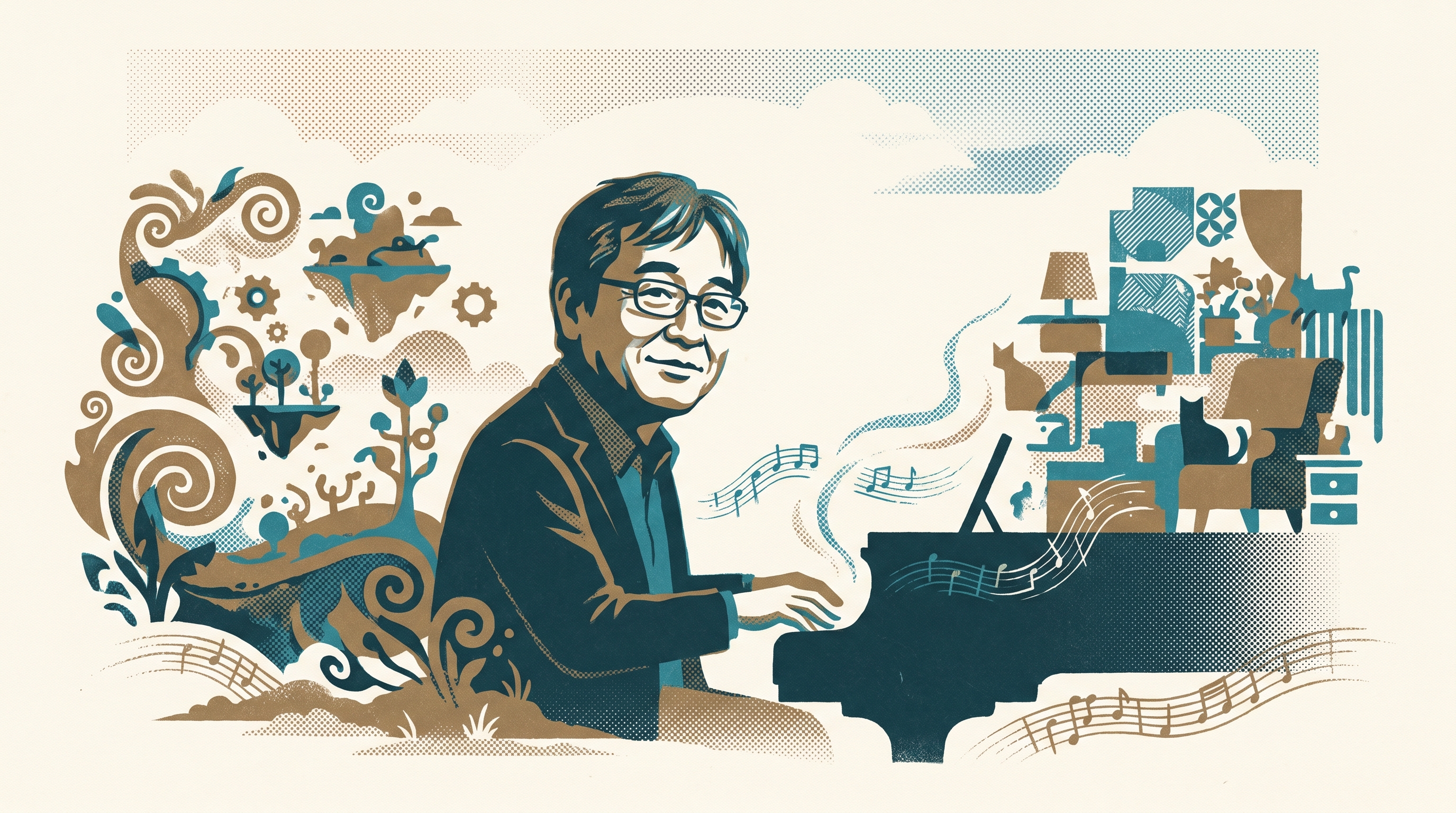
composer
Junichi Nakatsuru
中勝順一
He was a newcomer with no track record. They gave him an orchestra and asked him to define a fighting game. He did.
About
Junichi Nakatsuru is a Japanese video game composer and sound director at Bandai Namco Studios, best known for his orchestral work on the SoulCalibur series and the Ace Combat series. Born June 6, 1969 in Fukuoka, he studied at Osaka University of Arts, majoring in art while also studying music theory, acoustics, and desktop music. He joined Namco in 1998 after impressing the company with his demo tape, and was immediately given the lead composer role for the first SoulCalibur game. His approach to orchestral composition — heavily influenced by John Williams' Star Wars scores — helped define the sound of modern fighting games.
History
Junichi Nakatsuru was born on June 6, 1969, in Fukuoka, Japan. His parents arranged piano lessons, though he preferred playing his own arrangements of popular music over the assigned classical pieces. This quiet resistance to prescribed repertoire was the first sign of a composer who would later trust his instincts over convention. He attended Osaka University of Arts, where he majored in art but also studied music theory, acoustics, and desktop music production — a rare combination that would later allow him to bridge creative vision with technical execution.
In 1998, at twenty-nine years old, Nakatsuru applied to become an in-house composer at Namco. The company was known for arcade hits like Pac-Man and Tekken, but Nakatsuru's demo tape stood out. Despite being a newcomer with no published game credits, he was hired — and immediately given responsibility for the soundtrack of SoulCalibur, the arcade fighting game Namco was developing. This was not a small assignment. SoulCalibur was meant to be a flagship title, and the music would need to carry the weight of swordplay, mythology, and global stages. Nakatsuru was an unknown composer being asked to define the sound of a new franchise.
He chose to work with a full orchestra. Fighting games at the time leaned heavily on electronic music and synthesized rock. SoulCalibur\'s competitors — Street Fighter, Tekken, Virtua Fighter — all embraced modern, high-energy soundscapes. Nakatsuru went the opposite direction. He wrote sweeping orchestral pieces with layered strings, brass fanfares, and percussion that felt cinematic rather than competitive. The influence of John Williams\' score for Star Wars: Episode I – The Phantom Menace was clear in the way Nakatsuru structured his themes — melodic, operatic, and designed to evoke grandeur rather than aggression. SoulCalibur was released in arcades in 1998, then ported to the Dreamcast in 1999. The game was acclaimed not just for its gameplay, but for its sound. Nakatsuru had succeeded.
After SoulCalibur, he became Namco\'s go-to composer for orchestral work. In 2003, he was brought onto Ace Combat 5: The Unsung War, a flight combat simulator that demanded a very different emotional register — not the clash of swords, but the isolation of a cockpit, the weight of war, the quiet between missions. Nakatsuru adapted. He continued to work on later Ace Combat titles (Ace Combat Zero: The Belkan War, Ace Combat 6: Fires of Liberation, Ace Combat 7: Skies Unknown) and returned to SoulCalibur for its sequels, including SoulCalibur V and SoulCalibur VI. Over two decades, he composed music for more than a dozen major titles, all while maintaining the orchestral voice he established in 1998.
In a 2012 interview about SoulCalibur V, Nakatsuru explained that full orchestras were not always used for every track. Instead, the team combined instruments to create music with an \'orchestral feel,\' balancing live recording with practical constraints. This pragmatism — knowing when to record live and when to simulate — reflected a composer who understood both artistry and production. He was not chasing perfection. He was chasing the feeling of an orchestra, which is not the same thing.
Junichi Nakatsuru's career is a case study in the value of trusting one choice and following it all the way through. He was given an orchestra when he had no track record, and instead of hedging or following trends, he leaned into what he knew: the sound of cinematic grandeur, the weight of strings, the clarity of a melody you can remember after one listen. That choice became a signature. And that signature became a career.
Timeline & Works
Career milestones and all 2 games in the museum they worked on — in the order they happened.
- 1969 06
Born in Fukuoka
Junichi Nakatsuru was born on June 6, 1969, in Fukuoka, Japan.
people - 1998
Joined Namco
At age twenty-nine, Nakatsuru joined Namco as an in-house composer after impressing the company with his demo tape.
people - 1998
SoulCalibur (arcade)
As a newcomer with no published credits, Nakatsuru was given the lead composer role for SoulCalibur. His orchestral score helped define the sound of the franchise.
product - 1999
SoulCalibur (Dreamcast port)
The Dreamcast port of SoulCalibur was acclaimed for both its gameplay and its orchestral soundtrack.
product - 1999
- 2003
Ace Combat 5: The Unsung War
Nakatsuru contributed orchestral compositions to Ace Combat 5, adapting his style to the emotional weight of war and flight combat.
product - 2003
- 2006
Ace Combat Zero: The Belkan War
Continued his orchestral work for the Ace Combat series.
product - 2007
Ace Combat 6: Fires of Liberation
Composed music for Ace Combat 6, further cementing his reputation as Namco's orchestral specialist.
product - 2012
SoulCalibur V
Returned to the SoulCalibur series as lead composer. In interviews, he explained his approach to balancing live orchestration with production constraints.
product - 2018
SoulCalibur VI
Composed music for SoulCalibur VI, maintaining the orchestral signature he established two decades earlier.
product - 2019
Ace Combat 7: Skies Unknown
Contributed orchestral compositions to the latest Ace Combat title, continuing a career spanning over two decades.
product
Connections
- employed namco (1998–present)
Joined Namco in 1998 and became the lead orchestral composer for the SoulCalibur and Ace Combat series. Currently works at Bandai Namco Studios.
Also connected to
- Yoshihito Yano co-created SoulCalibur II / co-created Soulcalibur
Explore the work
Each title has its own page — history, trivia, and collector's notes.
Rooms their games live in
Sources
- Junichi Nakatsuru — Wikipedia (English) — accessed 2026-06-22
- VGMO — Junichi Nakatsuru Profile — accessed 2026-06-22
- The Sounds of SoulCalibur V: Interview with Junichi Nakatsuru (February 2012) — accessed 2026-06-22
- Junichi Nakatsuru — MobyGames — accessed 2026-06-22