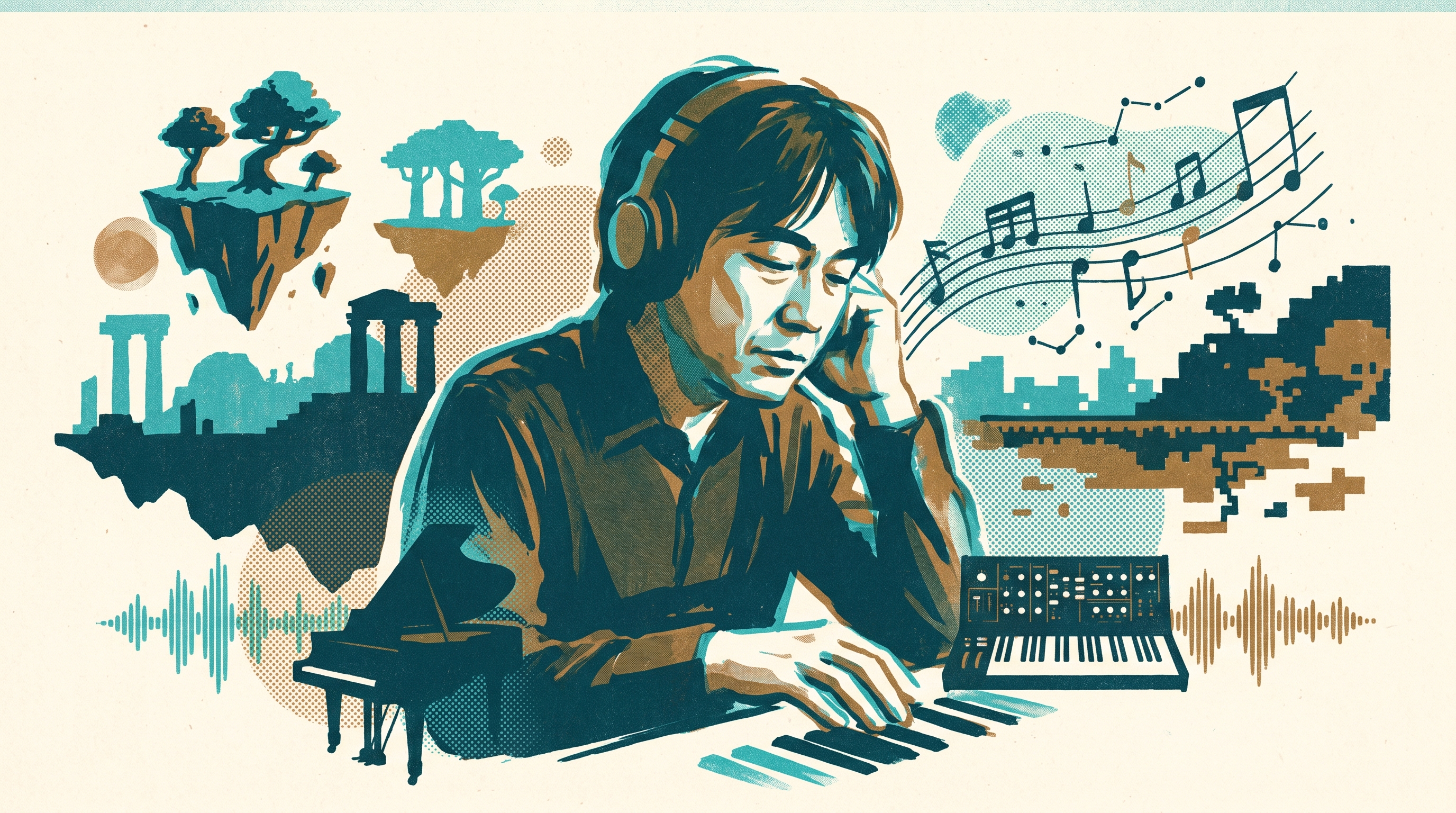
composer
Yoshihito Yano
矢野義人
Don't make game music. Make music that happens to live in a game.
About
The Bandai Namco composer who turned the King of All Cosmos's absurd world into sound — and made you hum along.
History
Yoshihito Yano was born on October 3, 1973, in Matsuyama, Ehime Prefecture. As a child, he spent hours copying pop music and game scores by ear — not from sheet music, but from listening and replaying until his fingers found the patterns. In college, he joined a band circle. Music was not a distant ambition. It was something he had already been doing, quietly, for years.
He joined Namco in the mid-1990s, when the company was moving into 3D arcade hardware and preparing the original PlayStation library. His first credited work was Alpine Racer 2, released in 1996. He was responsible for the sound effects — the crunch of snow, the scrape of edges, the wind across a digital slope. It was not glamorous work, but it was a foothold.
In the early 2000s, Namco gathered a small sound team for an unusual project. The director, Keita Takahashi, had proposed a game in which a tiny prince rolled objects into an expanding ball to rebuild the stars. The concept made no conventional sense. The sound director, Yuu Miyake, assembled a team of composers and asked each to contribute tracks. Yano was among them. The game was called Katamari Damacy, released in Japan on March 18, 2004.
Katamari Damacy's soundtrack did not sound like other game music. It mixed jazz, samba, electronica, and orchestral flourishes into something that felt less like background and more like a living, breathing companion to the absurdity onscreen. Yano contributed several tracks, including 'Lonely Rolling Star,' which became one of the series' most recognizable pieces — a bright, melancholic pop song that somehow fit the act of rolling up thumbtacks and bananas into a cosmic lump. The game sold modestly in Japan, became a cult phenomenon in North America, and the music traveled farther than anyone expected.
Over the following decade, Yano became one of Bandai Namco's most versatile composers. He worked across the Tekken series, contributing battle themes that ranged from orchestral intensity to electronic grit. He scored tracks for the Soulcalibur series and served as sound director on Soulcalibur Legends and Tekken 6. He contributed to the Taiko no Tatsujin rhythm game series and later worked on the soundtracks for Super Smash Bros. for Wii U and 3DS, and Super Smash Bros. Ultimate. His music did not belong to a single genre. It moved where the project needed it to go.
In a 2013 interview at MAGFest, Yano spoke about his approach to composition. He said he did not think of himself as making 'game music' in the traditional sense. He wanted to create music that felt like it existed in its own world — music that players would listen to outside the game, not because it reminded them of gameplay, but because it stood on its own. He said he was fond of the memory of playing Ridge Racer on the PlayStation right after its release, and that experience shaped how he thought about sound and immersion.
Yano continues to work at Bandai Namco Studios as a lead sound designer. He has been credited on over two hundred albums and dozens of game projects. The Katamari soundtracks are still streamed, covered, and remixed by musicians around the world. What he built was not just background music. It was a proof that game sound could be as strange, joyful, and uncompromising as the worlds it accompanied — and that a composer who listened carefully could turn the absurd into something you cannot stop humming.
Timeline & Works
Career milestones and all 2 games in the museum they worked on — in the order they happened.
- 1973 10
Born in Matsuyama, Ehime
Yoshihito Yano was born on October 3, 1973. From childhood, he copied pop music and game scores by ear, building a musical foundation that would later define his career.
people - 1996
Debut at Namco: Alpine Racer 2
Yano's first credited work at Namco was Alpine Racer 2, where he created the sound effects. It was his entry point into professional game audio.
product - 1999
- 2003
- 2004 03
Katamari Damacy Released
Katamari Damacy launched in Japan on March 18, 2004. Yano contributed several tracks including 'Lonely Rolling Star,' which became one of the series' most iconic pieces.
product - 2007
Sound Director: Soulcalibur Legends
Yano also directed the sound for Soulcalibur Legends, expanding his role across multiple major Namco series.
leadership - 2007
Sound Director: Tekken 6
Yano served as sound director for Tekken 6, overseeing the entire audio landscape of one of Namco's flagship fighting game franchises.
leadership - 2013
MAGFest Interview
At MAGFest 13, Yano and Yuu Miyake discussed their philosophy of creating music that exists in its own world, not just as game background.
milestone - 2014
Super Smash Bros. for Wii U / 3DS
Yano contributed tracks to the Super Smash Bros. series, bringing his sound to Nintendo's flagship crossover.
product - 2018
Super Smash Bros. Ultimate
Yano returned to contribute music for Super Smash Bros. Ultimate, cementing his role as a cross-company composer.
product
Connections
- collaborated with yuu-miyake (2004–present)
Yano and Yuu Miyake worked together on the Katamari Damacy series, with Miyake serving as sound director and Yano as a key composer.
Also connected to
- Junichi Nakatsuru co-created SoulCalibur II / co-created Soulcalibur
Explore the work
Each title has its own page — history, trivia, and collector's notes.
Rooms their games live in
Sources
- Yoshihito Yano — VGMdb — accessed 2026-06-22
- List of Bandai Namco composers — Nintendo Wiki — accessed 2026-06-22
- Yuu Miyake and Yoshihito Yano Interview: MAGFest 13 — VGMO — accessed 2026-06-22
- What 'Fun for All into the Future' Means to Me — Bandai Namco Studios — accessed 2026-06-22
- Music of the Katamari Damacy series — Wikipedia — accessed 2026-06-22
- Katamari Damacy — Wikipedia — accessed 2026-06-22